
A technical guide for ProAV and Broadcast equipment manufacturers — from certification to silicon deployment
Authors: Spencer Deame, Nextera Video and Rob Green, AMD
Introduction
The Internet Protocol Media Experience (IPMX) has entered a new phase. Backed by the Alliance for IP Media Solutions (AIMS), the Video Services Forum (VSF), the Advanced Media Workflow Association (AMWA), and the European Broadcasting Union (EBU), the official IPMX testing and certification program is now live, and at ISE 2026 the industry unveiled its first wave of certified products. Manufacturers can now evaluate IPMX as a deployable standard rather than a promising framework.
For ProAV and Broadcast equipment vendors, that shifts the conversation from readiness to execution: what IPMX solves, what certification actually verifies, and how to bring interoperable products to market efficiently.
This article walks through what IPMX is, how the certification program works, what the first certified products tell us, what early deployments are showing, and how Adeas-Nextera FPGA IP cores running on AMD adaptive silicon can help manufacturers reach certifiable products faster.
What Is IPMX?
Built on the proven foundation of SMPTE ST 2110 and AMWA NMOS, IPMX adapts broadcast-grade open standards for use across ProAV and unified communications environments. At its core, IPMX decouples video, audio, and ancillary data into independent IP streams, enabling highly scalable routing over standard Ethernet infrastructure.
IPMX is an open, certifiable standard for professional AV-over-IP, with specifications publicly available at vsf.tv and a public product registry at ipmx.io.
For commercial AV environments, IPMX adds capabilities beyond a conventional ST 2110 deployment:
- Flexible Timing: Native support for both IEEE 1588 PTP synchronization and fully asynchronous operation, enabling deployment on everything from a broadcast facility with a dedicated grandmaster to a standard university IT switch.
- EDID over IP (NMOS IS-11): Automated format negotiation between source and display devices over IP — the equivalent of the EDID handshake that HDMI and DisplayPort users take for granted, now available across a multi-vendor IP network.
- Compressed Video Support: JPEG XS enables visually lossless 4Kp60 4:4:4 transport over 1G/2.5G copper networks with sub-millisecond latency.
- HDCP Content Protection: Encryption and decryption of commercially protected content within the IP stream, enabling ProAV deployments that carry DRM-protected material.
- Privacy Encryption Protocol (PEP): Interoperable content-layer encryption across multi-vendor infrastructure, relevant to healthcare, government, and enterprise environments with security requirements.
- USB Extension (Upcoming): USB 2.0 transport over IPMX to extend KVM workflows and USB-enabled peripherals over IP, currently in multi-vendor testing ahead of formal certification.
The complete set of IPMX specifications is published by the VSF as the TR-10 series of technical recommendations.
The IPMX Certification Program
From “IPMX Ready” to “IPMX Certified”
Before January 2026, manufacturers could build “IPMX Ready” products that demonstrated feasibility and a good-faith implementation of the specifications. The designation was useful for early market development and interoperability testing, but it did not provide the same level of independently verified interoperability assurance as formal certification.
The launch of the IPMX Certified program changes this entirely. The inaugural IPMX Product Testing and Certification Event took place in January 2026, hosted by the European Broadcasting Union (EBU) in Geneva, Switzerland. The EBU’s role as a neutral, independent testing authority — with deep expertise in broadcast IP standards — gives the industry confidence that products earning official certification meet the full requirements for IPMX compliance and interoperability.
| Key principle: Certification is structured as pass/fail: a product either meets the certification requirements in full or it does not. There is no tiered or partial designation. |
What Certification Validates
The certification program is designed to ensure three verifiable outcomes across all certified products, regardless of manufacturer:
- Predictable system behavior: Products behave consistently and as documented under defined test conditions.
- Reliable multi-vendor interoperability: Certified products from different manufacturers work together within the scope of the tested specifications and profiles, without custom configuration or integration work.
- Adherence to published test plans: Compliance with VSF TR-10 technical recommendations and associated IPMX specifications, as administered by an independent test authority.
Certified products carry official IPMX branding, giving integrators and end-users an unambiguous signal of verified compliance. The IPMX registry at ipmx.io serves as the authoritative public record of certified devices, including which specifications were tested and when.
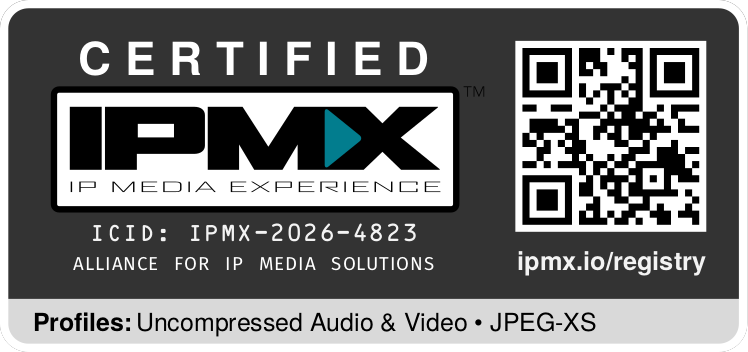
Each IPMX Certified product carries an official badge with a unique ICID number, a registry QR code, and the specific IPMX profiles verified during testing.
What’s Certifiable Today and What’s Coming
The first certification event covered core transport, timing, and control specifications:
- Uncompressed video transport per SMPTE ST 2110-20
- JPEG XS compressed video transport per VSF TR-08/TR-10 IPMX profiles
- AMWA NMOS IS-04 (Discovery), IS-05 (Connection Management), and IS-11 (Stream Compatibility / EDID over IP)
- Asynchronous timing operation (without PTP)
Several additional capabilities are in multi-vendor testing and are expected to move toward certification later in 2026:
- HDCP and HKEP (HDCP Key Exchange Protocol): For content-protected media transport across multi-vendor IPMX systems.
- PEP (Privacy Encryption Protocol): For encrypted media streams, with demonstrated multi-vendor interoperability already achieved in pre-certification testing.
- USB 2.0 Extension with PEP: For KVM and USB-enabled workflows, including encrypted USB traffic over IPMX.
- HEVC and AVC Compression Profiles: Meeting strong industry demand for more bandwidth-efficient codecs beyond JPEG XS, nearing completion for submission to certification.
A second certification event is planned for later in 2026, with expanded manufacturer participation expected. The program is also evolving to allow testing at multiple facilities worldwide, reducing the logistical burden of a single-location event. Long-term, the AIMS registry will be expanded to include additional transport and product specifications, providing a more complete picture of device capabilities and interoperability scope.
The First Wave of IPMX Certified Products
At ISE 2026 in Barcelona, 48 products from 11 manufacturers officially received IPMX Certified status. The certified manufacturers include Adeas/Nextera, Bridge Technologies, Cobalt Digital, Evertz, intoPIX, Matrox, Megapixel VR, Novastar, Panasonic, and PlexusAV.
The first wave matters less for its raw product count than for its breadth. The certified group spans the complete signal chain: endpoints (encoders, decoders, and bidirectional transceivers), gateways that bridge IPMX to SDI and to legacy cabling such as HDBaseT, network monitoring and analysis tools, LED processing and display platforms, and FPGA IP reference designs. That spread suggests IPMX is no longer confined to lab demonstrations or single-category implementations; it is beginning to support complete deployment architectures.
Each category proves a different aspect of that maturity. Certified endpoints prove usable source-to-display interoperability. Gateways prove coexistence with the installed base, letting facilities blend new IP switching with cabling and SDI gear that won’t be replaced overnight. Monitoring tools prove operational readiness for multi-vendor networks. Display platforms prove the signal chain works end to end, from source encoder to final pixel under a single standard. And FPGA IP reference designs prove manufacturability: rather than finished products, these are certified implementations of the IPMX specification delivered as RTL IP cores, giving other manufacturers a validated foundation to build on instead of implementing the specification from scratch.
How ProAV and Broadcast Are Each Adopting IPMX
Broadcast: ST 2110 Made Easy
Broadcasters were the architects of ST 2110, and many have significant ST 2110 infrastructure already deployed. For them, IPMX is less a revolution and more a strategic extension — what practitioners in the industry have begun calling “ST 2110 made easy.”
The primary appeal for broadcasters is IPMX’s flexible timing model. Traditional ST 2110 deployments mandate a network-wide PTP grandmaster with PTP-capable switches throughout the facility. That suits large national broadcasters but adds real cost and engineering overhead for smaller regional stations, mobile units, and owned-and-operated affiliates, which often run on existing IT infrastructure. IPMX’s asynchronous mode reduces that requirement wherever facility-wide synchronization isn’t necessary, opening IP-native workflows to these facilities without a full infrastructure rebuild.
Healthcare is another emerging vertical. IPMX’s PEP encryption supports the security needs that matter in regulated environments such as healthcare, where protected health information must be safeguarded, giving the standard a credible answer to requirements that earlier AV-over-IP approaches handled inconsistently. Broadcast vendors with existing ST 2110 product lines are well-positioned here, bridging the ST 2110 broadcast world and the IPMX ProAV ecosystem on the same network.
ProAV: The End of Proprietary Lock-In
For the ProAV industry, IPMX represents something more fundamental than a technical upgrade. It represents a structural break from decades of proprietary ecosystem fragmentation.
Corporate AV, higher education, houses of worship, and live events have long been served by a small number of dominant proprietary AV-over-IP platforms. While these solutions delivered functional results, they created vendor lock-in that constrained system design, inflated long-term costs, and made multi-vendor integrations needlessly complex. Integrators were effectively required to commit to a single manufacturer’s ecosystem for every component of an installation — or face difficult compatibility challenges.
IPMX offers a standards-based alternative to this model. Because certified products are designed to interoperate across vendors within the scope of the certified profiles, system designers can evaluate components on their merits: price, form factor, feature set, power consumption, and support quality. Cameras, encoders, and decoders from different vendors can work together in one certified system without custom integration work.
This shift is already visible in the composition of the first certified product wave. The 11 manufacturers represent a mix of broadcast-heritage companies and ProAV specialists, LED processors and network analyzers, IP core developers and end-product manufacturers. IPMX is, for the first time, giving system designers a common language that works across the entire ProAV signal chain.
What Early Deployments Are Teaching Us
Early deployments and implementation work, across enterprise campuses, broadcast centers, houses of worship, and higher education, are already highlighting several practical lessons.
1. Timing Flexibility Changes the Economics
One of the clearest early lessons is about timing architecture. In traditional ST 2110 environments, PTP is mandatory, requiring specialized switches with transparent or boundary clocks throughout the network. This adds cost and engineering complexity, particularly for installations that otherwise run on standard IT infrastructure.
IPMX’s asynchronous mode eliminates this constraint for environments where microsecond-level synchronization is not required. Endpoints lock to local clocks or video-locked timing without a network-wide grandmaster. This simplifies the bill of materials, reduces dependency on specialized networking vendors, and enables reliable transport over ad-hoc event networks where deploying a PTP grandmaster would be impractical or impossible.
For installations where precise synchronization is required — video walls, multi-screen displays, broadcast-grade live event production — IPMX fully supports PTP, providing the same timing precision as pure ST 2110. The flexibility to choose the timing model appropriate for each deployment is one of IPMX’s most practically valuable differentiators.
2. NMOS IS-11 Provides EDID over IP
In a traditional HDMI or DisplayPort environment, EDID negotiation between source and display happens automatically and transparently. In IP-based AV systems without IPMX’s IS-11 specification, this negotiation had to be performed manually — identifying capability mismatches, configuring formats by hand, and troubleshooting incompatibilities during installation.
NMOS IS-11 (Stream Compatibility Management) brings EDID-equivalent automated behavior to IP media systems. Control platforms can query a device’s declared capabilities and enforce format compatibility constraints before establishing a connection — preventing format mismatches before they occur. In multi-vendor IPMX deployments, this eliminates an entire class of integration problems that previously required on-site troubleshooting to resolve, reducing installation time and support costs.
3. Compression Opens the Market to Existing IT Networks
One of the most significant practical findings from early deployments is the role of compressed IPMX transport in enabling adoption on existing network infrastructure. Uncompressed IPMX streams require 10G, 25G, or 100G network links — infrastructure that is standard in broadcast facilities and high-end enterprise installations, but not universal.
IPMX compression profiles change this equation. JPEG XS achieves visually lossless 4:4:4 10-bit performance with sub-millisecond latency, enabling 4Kp60 transport over existing 1G and 2.5G copper networks. That extends IPMX from facilities with modern high-speed networks to a much broader installed base of existing Ethernet infrastructure.
4. IPMX Bridges Broadcast and ProAV Infrastructure
One of the most strategically useful patterns is how cleanly IPMX bridges broadcast and ProAV signal chains. Because it natively handles both ProAV requirements (HDCP, EDID via IS-11, asynchronous timing, compressed transport over 1G) and broadcast-grade capabilities (uncompressed ST 2110, PTP, NMOS), a single IPMX infrastructure can serve both domains at once.
That matters for facilities that straddle both worlds: local stations with corporate operations, performing arts venues with broadcast partnerships, and universities with both academic AV and broadcasting programs. A shared IPMX layer removes the need to build and maintain two separate, incompatible IP stacks.
5. Security and Trust Are Now First-Class Requirements
Early deployments have also surfaced a market reality: customers in healthcare, government, finance, and enterprise are asking about security before they ask about bandwidth or latency. Historically, security in AV-over-IP environments has been inconsistent across vendors, with manufacturers implementing their own proprietary approaches to access control and encryption that could not interoperate across systems.
IPMX addresses this at two layers. At the media layer, PEP (Privacy Encryption Protocol) provides a common, interoperable method for encrypting content between devices from different manufacturers. At the control layer, AMWA IS-10 defines authentication and authorization on widely used IT standards: TLS, OAuth 2.0, and JSON Web Tokens. Together these let systems verify device identity and manage permissions in a consistent, IT-friendly way, though security features are one part of a broader deployment and governance picture rather than a complete answer to it.
Accelerating IPMX Development with Adeas‑Nextera and AMD
For manufacturers, the remaining challenge is less about understanding IPMX than about implementation: how to reduce development risk, shorten integration time, and reach certification without building every element in-house. One practical route is to start with pre-validated IP cores and reference designs. The Adeas-Nextera and AMD combination is one example of this platform-level approach.
The Adeas‑Nextera FPGA IP Core Platform
Nextera Video and Adeas have developed ST 2110 and IPMX FPGA IP cores since the standard’s earliest days, with cores deployed and proven in products from dozens of manufacturers worldwide. The solution includes RTL IP cores, supporting software (drivers, daemons, and NMOS control), a complete transmit and receive reference design, and a web GUI.
The Adeas-Nextera HDMI IPMX TX/RX IP Reference Design was certified at the inaugural Geneva event, letting customers start from a working, validated system and customize it to their product requirements rather than building from scratch. Design services are also available for customers with limited FPGA engineering capacity.
The IP core package covers the full IPMX specification set:
- SMPTE ST 2110-20 (uncompressed video transport)
- SMPTE ST 2110-30/31 (audio transport)
- SMPTE ST 2059 (PTP synchronization)
- IPMX asynchronous timing support
- AMWA NMOS IS-04 (Discovery), IS-05 (Connection Management), and IS-11 (Stream Compatibility / EDID over IP)
- HDCP encryption and decryption
- PEP (Privacy Encryption Protocol)
- JPEG XS compression via intoPIX integration
The solution is fully modular, allowing manufacturers to include only the IP blocks relevant to their product. It is resolution and network-speed independent, scaling from compressed 1G endpoints all the way to 8K+ uncompressed streams over 100G links.
AMD FPGAs and Adaptive SoCs: The Right Silicon for IPMX
AMD FPGAs and adaptive SoCs are well suited to the performance, flexibility, and integration requirements of IPMX implementations. Unlike fixed-function ASICs, programmable devices can be tailored to each product, supporting specific video formats, custom timing behaviors, direct integration with multi-channel HDMI, DisplayPort, SDI, and USB interfaces, whilst providing room for custom differentiated AV processing. A single silicon platform can serve multiple product SKUs, amortizing development costs across a portfolio.
Key AMD platforms for IPMX product development include:
- AMD Zynq™ UltraScale+™ MPSoC: Combines high-capacity programmable logic with quad-core Arm® Cortex-A53 and dual Cortex-R5 processors plus integrated transceivers, and in select MPSoCs, an integrated H.264/H.265 4K60 4:2:2 10-bit codec. Suited to multi-channel gateways, broadcast-grade infrastructure, and high-end endpoints that run media processing and NMOS control on one device. Integrated 25G transceivers connect directly to 10G and 25G Ethernet without external PHYs.
- AMD Kria™ SOM (based on Zynq UltraScale+): A production-ready, thermally characterized System on Module that delivers Zynq UltraScale+ capability without a custom carrier board, reducing hardware development effort and time-to-market.
- AMD Zynq™ 7000 Series SoC: The cost-optimized option for high-volume ProAV products including wall plates, throw-down boxes, compact gateways, and edge devices. When combined with the Adeas-Nextera-intoPIX joint solution, the Zynq 7000 Series MPSoC acts as a fully integrated IPMX “virtual ASIC.”
- AMD Versal™ Adaptive SoC: The most advanced programmable platform offered by AMD, combining scalar engines, adaptable engines, and AI-capable processing units as well as an integrated H.264/H.265 4K60 4:4:4 12-bit codec in select family members. Suited to next-generation products needing high channel density, AI-assisted stream analysis, and power efficient advanced compression.
The Cost-Optimized Virtual ASIC: IPMX for Mass-Market ProAV
At ISE 2026, AMD, Adeas, Nextera Video, and intoPIX jointly announced a cost-optimized solution for high-volume, cost-sensitive ProAV products. It uses an AMD Zynq 7000Series SoC pre-loaded with a single bitfile containing the IPMX IP from Adeas, NMOS control software from Nextera, and TicoXS JPEG XS compression from intoPIX. The result is a single-chip, turn-key implementation that behaves as a virtual ASIC, letting manufacturers with or without FPGA expertise add IPMX without building an FPGA design team.
The virtual ASIC solution supports:
- One channel of visually lossless 4Kp60 4:4:4 video and audio transmit or receive
- Transport over standard 1G/2.5G copper networks — no high-speed Ethernet infrastructure required
- IPMX per VSF TR-10 with JPEG XS IPMX profile
- NMOS including IS-11 for EDID
- PEP (Privacy Encryption Protocol) and HDCP for content security
“This cost-optimized virtual ASIC allows OEMs with or without FPGA expertise to IPMX-enable their products quickly and easily,” said Jed Deame, CEO of Nextera Video. “By reducing the cost and complexity of IPMX implementation, we are driving mass-market adoption where equipment manufacturers, system integrators, and end users all win.”
“The flexibility and level of performance required means programmable logic devices such as FPGAs and adaptive SoCs are ideally suited to a broad range of Pro AV applications,” said Ramesh Iyer, Senior Director, Pro AV, Broadcast & Consumer at AMD. “By partnering with the leaders in AV-over-IP cores, we are providing a streamlined path for manufacturers to adopt IPMX without compromising on cost or performance.”
This solution is targeted at high-volume product categories where cost and size are critical: wall plates, IP transmission dongles, throw-down boxes, set-top decoders, and display-integrated IPMX receivers.
A Scalable Architecture for Every IPMX Product
The same combination scales across the full range of IPMX product architectures. For endpoints, AMD platforms handle serialization, color-space conversion, chroma subsampling, and HDCP cryptography in hardware at sub-frame latency, with transceivers connecting directly to HDMI and SDI PHYs to cut external components and costs.
For gateways, integrated multi-rate Ethernet MACs (1G to 100G) and hardware buffering aggregate many streams and manage timing between PTP-locked broadcast domains and asynchronous ProAV networks.
For transcoding, the fabric hosts parallel codec cores, and the Zynq UltraScale+ MPSoC’s hardened H.264/H.265 blocks suit high-density conversion at low power.
And for processing platforms such as switchers, scalers, and mix engines, the Arm cores in Zynq and Versal devices run NMOS discovery, connection management, and stream compatibility on-device, reducing the need for separate control processors.
Conclusion: IPMX Is Here — and the Time to Build Is Now
IPMX has crossed the threshold from emerging specifications to a deployable, certified standard. With 48+ certified products already in the field from 11 manufacturers, a formal certification program with a second event planned for later this year, and an expanding roadmap that adds HDCP, PEP, USB extension, and additional compression codecs to the certified specification set, the IPMX ecosystem is building momentum quickly.
For ProAV and Broadcast equipment manufacturers, building certified IPMX products is no longer a question of timing; the market infrastructure is in place. The question is execution: how to build interoperable products efficiently and at the right cost point.
Starting from validated IP cores, reference designs, and proven programmable silicon platforms is one practical way to reduce that development effort. The Adeas-Nextera and AMD solution combines a pre-certified IPMX reference design and a hardware platform that scales from cost-optimized Zynq 7000 Series SoCs to performance-optimized Zynq UltraScale+ and Versal devices, helping teams move toward IPMX certification with less risk.
The ProAV and Broadcast industries have been converging for years, and IPMX is the standard that finally gives them a common infrastructure. Manufacturers that move now, building on validated IP cores and programmable silicon platforms, can help shape that market while reducing development risk and time-to-market.
To learn more about the Adeas-Nextera IPMX IP core solutions, visit nexteravideo.com.
For more information on the AMD FPGAs and Adaptive SoCs, visit amd.com.
Full IPMX specifications and the certified product registry are available at ipmx.io and vsf.tv.